Beretta 92FS and M9: Specs, Differences, and Buying a Used Police Trade-In
The Beretta 92FS and its military twin, the M9, are popular used pistols. This guide explains how the versions differ and what to check before you buy a used police trade-in.
92FS and M9: the basics
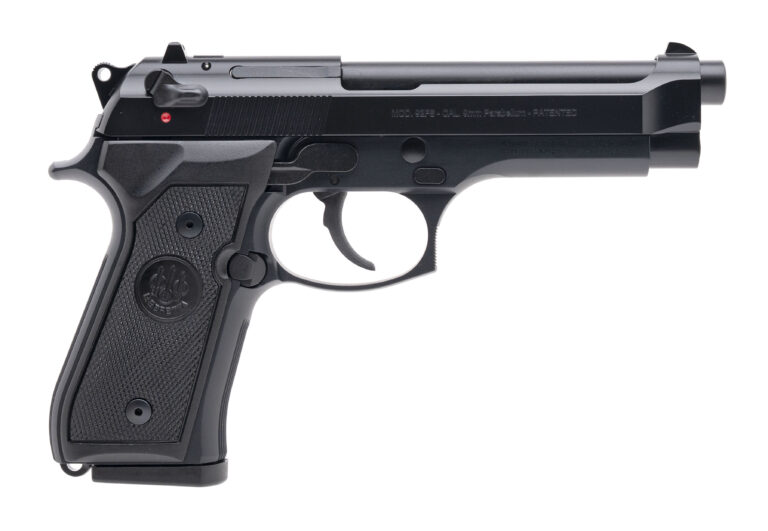
The Beretta 92 was designed in 1975 and production began in 1976. The 92FS is a 9x19mm Parabellum pistol. The M9 is the designation the US military uses for the 92FS. Both use a short recoil action with a falling locking block. The M9 uses a 15-round staggered magazine.
Published figures for the M9 are an overall length of about 217 mm and an unloaded weight of about 970 g (34.2 oz).
Model differences at a glance
| Model | What sets it apart |
|---|---|
| 92FS | Slide-mounted safety and decocker. Has an enlarged hammer pin that fits a groove under the slide, a hard-chromed bore and a Bruniton slide finish. |
| M9 | US military designation of the 92FS, adopted in 1985. |
| 92G | Decocker-only, with no manual safety. The G stands for the French Gendarmerie Nationale. |
| 96 series (for example 96FS) | The same family chambered in .40 S&W. Magazine sizes differ from the 9mm guns, so check the one you are buying. |
| M9A1 (2006) | Adopted by the US Marine Corps. One-slot Picatinny rail, more aggressive checkering, beveled magazine well, PVD-coated magazines. |
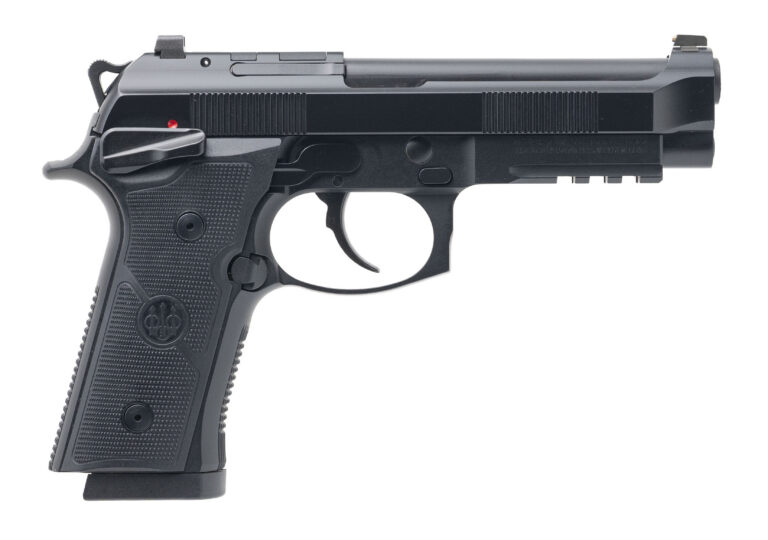
| 92A1 (2010) | Two accessory-rail slots and a round trigger guard. |
| M9A3 (2015) | Three-slot rail and 17-round sand-resistant magazines. |
| M9A4 (2021) | 18-round magazines, red-dot-ready slide, decocker-only. |
Markings can differ between civilian and military guns. Ask the seller for clear photos of the slide and frame, and read the listing carefully.
History and who used them
The US military adopted the M9 in 1985. It replaced the M1911A1 in the Army and Navy and the S&W .38 Special revolver in the Air Force. In 2017 the Army chose the SIG Sauer M17 and M18 through the Modular Handgun System program to replace it.
Wikipedia lists these law enforcement users of Beretta 92-family pistols: the Connecticut State Police and US Border Patrol (96D), the Prince George's County Police Department and the Los Angeles County Sheriff's Department. The French Gendarmerie used a licensed version of the 92G called the PAMAS G1. A trade-in gun may not have come from any of these, so ask where a specific pistol came from.
The slide issue, in plain words
During US military testing there were reports of slide failures. The 92FS was changed to have an enlarged hammer pin that fits a groove under the slide. This is meant to stop the slide leaving the frame to the rear if it cracks. Beretta found that the slides met specification. Later reports blamed the failures on ammunition loaded well above NATO specification. Still, look carefully at the slide of any used pistol, as described below.
What to check on a used police trade-in
Slide and frame
- Look for cracks, especially near the locking block area and the slide cut-outs. Do not buy a pistol with a cracked slide or frame.
- Check that the slide moves smoothly with no rough spots or side-to-side wobble.
- Holster wear is normal on trade-ins. Deep gouges, rust pits, or bulges are not.
Locking block and barrel
- The locking block locks the barrel to the slide. Check it for chips, cracks, or heavy battering.
- Look down the bore with a light. It should be clean, with sharp rifling. Check the muzzle for dings.
Trigger and decocker
- Test the double-action and single-action pull on an unloaded pistol. It should be smooth, and the trigger should reset.
- Test the decocker lever. It should drop the hammer smoothly. Ask the dealer to check this with you.
Finish
Finish wear on a trade-in is common and usually only cosmetic. Rust and deep pitting are a concern.
Magazines
Count the magazines that come with the pistol. Used magazines can have weak springs, bent feed lips, or cracked bodies. Check that each one seats fully, locks in, and drops free when you press the release. The magazine release button is reversible, so check it works the way you want.
Magazine and parts compatibility
Mec-Gar makes an 18-round magazine that fits flush in the 92 series. The 17-round magazines that come with A1 models and the 15-round sand-resistant magazines are reported to work in earlier 92-series and M9 pistols. Earlier 92 and 92S magazines may not fit later 92SB-style pistols unless they have notches in both places. Always match the magazine to the exact model and caliber, and do not mix 9mm and .40 S&W parts. Ask your dealer what fits your gun.
Buying through a licensed dealer
A licensed dealer (FFL) handles the transfer. You fill out ATF Form 4473, and the dealer runs a NICS background check through the FBI system. Under federal law, a gun sold across state lines goes through a licensed dealer. Your state may add its own rules, such as waiting periods or permits. Ask your dealer what applies where you live.
FAQ
Is an M9 the same as a 92FS?
The M9 is the US military designation for the 92FS. They are very close, but markings and finishes can differ, so check the pistol in hand.
Is a used police trade-in pistol a good buy?
It can be. Expect holster wear. Inspect the slide, locking block, trigger, decocker, and magazines before you decide.
Can this pistol be shipped to my house?
Not as a normal rule. Out-of-state sales go through a licensed dealer, where you complete Form 4473 and the NICS check. Ask your dealer about the steps in your state.
Used guns we have right now
These are in stock as used guns. Look at the photos for the exact condition, and know that they ship to a licensed dealer (FFL) near you.
- Beretta 92FS 9mm - $919.88
- Beretta 92GTS 9mm - $914.19
- Beretta M9 9mm - $1,374.19
- Beretta M9A3 Tactical 9mm - $977.44
General information, not legal advice. Current as of September 2026. Laws change; check the official source before you act.